
What Smyth County Tax Records Show
Two offices split the work in Smyth County. The Commissioner of the Revenue maintains the assessment card, and the county's VGSI service includes current and historic ownership, assessment, and building details. The Treasurer collects real-estate bills and fields delinquency questions. The live tax-account portal changes its search fields from time to time, so check the current options there rather than expecting a fixed form.
| Record detail | What it can answer | Custodian |
|---|---|---|
| Assessment card | Ownership, assessment, tax-map number, and building information described by the county | Commissioner of the Revenue |
| Tax bill | Current charge and collection status, subject to the Treasurer's available search tools | County Treasurer |
| Town tax account | Separate municipal charge or payment history for a town property | Relevant town |
| Assessment working papers | Methodology and comparable-sales material available under state law | Commissioner / custodian |
| Historic card information | Current and historic ownership information advertised by the county | VGSI public portal |
An assessed value is a figure built for taxation. It is not a sale price. A tax bill, in turn, is the amount due under the rate and billing rules for the year, so the county portal and the Treasurer's account each deserve a separate look. For value questions, weigh the assessment method and any recorded deed rather than reading the bill as an appraisal.
The Smyth County Reassessment Calendar
Smyth County's latest general reassessment took effect January 1, 2024. The next effective date is January 1, 2028. Assessment work begins in 2027. That calendar matters when a property owner compares a current tax value with a recent purchase or improvement. The assessed figure follows a set cycle and method rather than tracking the market day to day. It is not a live quote of what a buyer would pay today. The Commissioner also assigns tax-map numbers. The office coordinates transfers and updates with the Clerk and Treasurer. A card can be a strong starting point. It is not the newest legal proof of a transfer. When ownership has changed, compare it with the most recent deed records. Ask the office how a correction or review is handled. The county's reassessment schedule lists the effective dates and explains the public VGSI service.
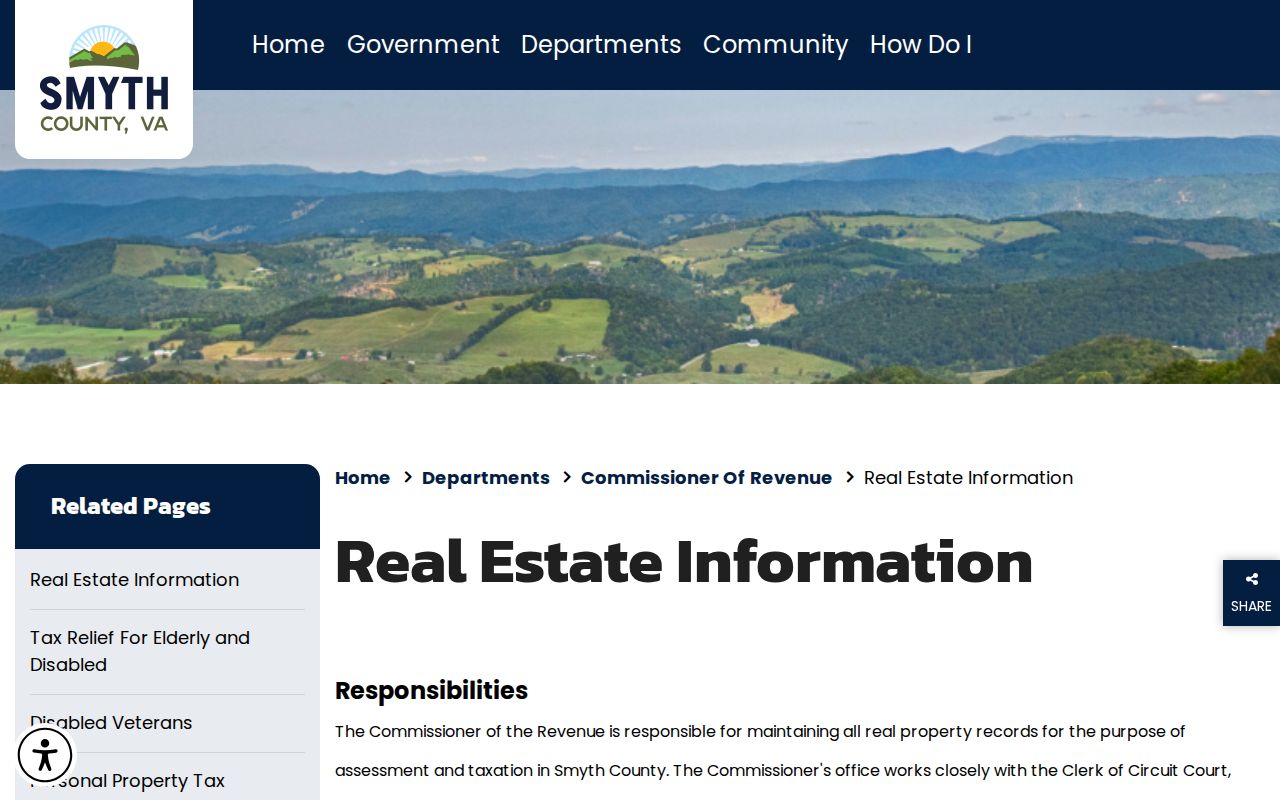
The county schedule sets the assessment cycle; the VGSI parcel card shows the details for an individual tract.
Smyth County's Rate and Assessment Ratio
Smyth County's published 2025 real-estate rate is $0.59 per $100 of assessed value. The rate is not the assessed value. Neither figure is the sale price. A basic county-tax calculation starts from assessed value. It then applies the rate, subject to the billing and taxing rules the Treasurer administers. Virginia defines the sales assessment ratio as assessed value divided by sale price. State material treats a 70% to 130% band as prima facie evidence in certain statutory settings. It is not a rule that every parcel must match its latest sale exactly. Market timing, property facts, and the county's reassessment process can all pull the figures apart. At the 2025 county rate, a $100,000 assessed value yields $590 in basic county tax. That figure comes before any bill-specific adjustments. That is an illustration, not a quote. Use the assessed figure and rate for the bill year. Then compare the actual tax bill with the Treasurer's account. A town parcel may carry a separate municipal account too. One jurisdiction's payment history does not prove every property charge is paid. For the value fields themselves, see the separate Smyth County property value explanation.
Follow a Smyth County Tax Bill
Start with the county's assessment card to match the property and its tax-map number. Then take collection, payment, or delinquency questions to the Treasurer's links or office. An online payment link is available from the county site. However, the full bill-search field list is not posted. Keep every account inquiry tied to the proper tax authority. This matters especially for a parcel inside a town.
- Match the parcel in VGSI and copy the tax-map number and situs address.
- Use Smyth County Treasurer services for the county bill and ask about payment status or delinquency.
- If the address is in a town, check whether a separate municipal account applies.
- For a disputed assessment, request the card and methodology material from the Commissioner.
Keep the tax year with every amount you record. The January 1, 2024 reassessment date and the 2025 county rate belong to different parts of the math: the reassessment sets the valuation cycle, while the rate applies to a particular fiscal tax year. Before comparing bills across years, confirm the parcel, assessment year, rate year, and taxing authority on each notice. A VGSI assessment card is not the county payment ledger. A recorded deed is not a tax receipt. Use the card to match the land and assessed value, and use the Treasurer's account for billed charges, credits, payments, or an asserted delinquency. When a town bill is involved, keep the town and county account numbers separate so a payment posted to one system is not mistaken for the other.
- Assessed value
- The county's valuation used in its property-tax calculation.
- Tax rate
- The amount applied per stated unit of assessed value; Smyth publishes a per-$100 rate.
- Assessment card
- The county's real-estate record describing ownership, assessment, and building information.
- Tax lien
- A claim tied to unpaid tax; check the Treasurer and recorded instruments for the parcel.
Marion's Separate Smyth-Area Tax Ticket
A Marion address often carries two tax tickets. One sits with Smyth County. The other belongs to the town itself. The town's e-Treasurer portal searches real-estate tax by name, account number, department, bill number, or parcel number, and it shows payment history along with yearly taxes paid. Utility searches run separately from the real-estate inquiry.
Keep the town bill separate from the county VGSI assessment. When a name, account, or parcel number does not match the expected property, verify the municipal record with Marion's Clerk-Finance office. That office sits at 138 West Main Street, Marion, open weekdays from 8:30 a.m. to 5:00 p.m.
Use the Marion real-estate tax portal for its own account search and payment history.
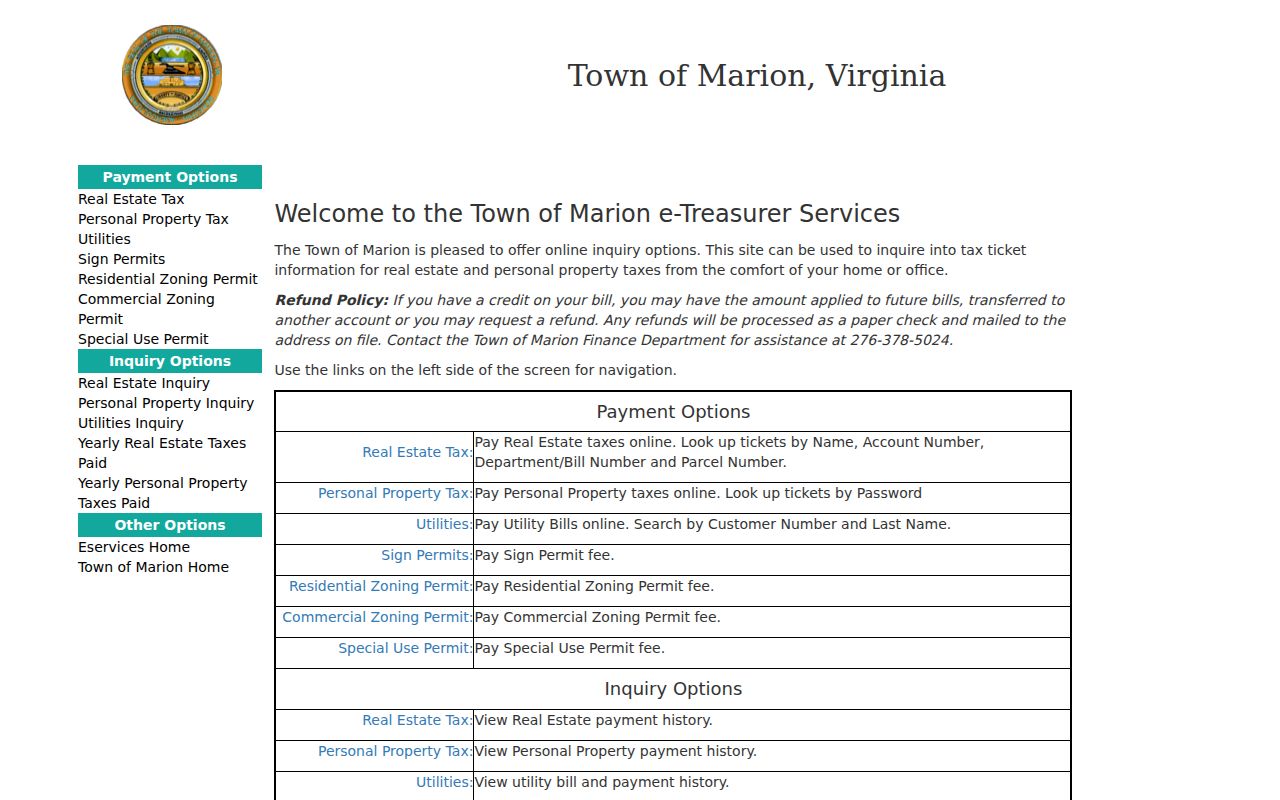
The town portal lists the municipal search keys for Marion parcels.
Read it as a second tax layer on top of the county's bill.
Working Papers for a Smyth Assessment Review
Virginia Code § 58.1-3331 makes nonconfidential real-estate appraisal cards generally open for inspection. It also allows a taxpayer to request working papers and methodology, including comparable sales and formulas. Those papers help a reader understand the assessment basis rather than relying on a number alone.
Tax-return information is treated differently and is confidential under § 58.1-3. The public status of an appraisal card does not open every tax document connected to a person. When requesting material, identify the parcel and ask the Commissioner which card or methodology records are available for inspection.
Virginia's assessment-card statute describes these disclosure and methodology provisions.
Checking Smyth County Delinquency Claims
The county website links Treasurer resources and an Excess Tax Sale Proceeds page. It publishes no live delinquent-tax list, full sale calendar, redemption guide, or proceeds form. Ask the Treasurer for the current status. Do not trust an old notice or an outside summary. A tax bill or delinquency entry alone proves no foreclosure or transfer. Before accepting a claim that a parcel was sold, gather the right records. The Treasurer notice shows one stage. The Circuit Court record shows another. The deed or trustee's deed recorded with the Clerk confirms what actually changed title. A court order or release may matter too. Match the parcel number and dates across each source before drawing any conclusion. The Smyth County Treasurer page is the local place to start for collection questions.
Town Boundaries and Smyth Tax Records
Marion, Saltville, and Chilhowie are incorporated towns. Their property assessment and deed trail still runs through Smyth County systems. Town zoning, permits, and municipal tax accounts sit beside that county record. A mailing address proves nothing about the legal line. Neither does a ZIP code. For a parcel near a town edge, compare the county tax-map number and GIS location. Then check the tax authority named on each bill. Wait until the taxing body and billing period are clear. Then add town and county charges together. One parcel can carry a Smyth County assessment and a separate municipal account. Neither is a duplicate of the other. Check the owner of record in both systems. That helps confirm you are reading the same land.
Reviewing a Smyth County Assessment
Virginia expects assessments to track fair market value. The appraisal card sits open for inspection under Code § 58.1-3331 once a reassessment notice goes out. That card is the assessor's working summary of a parcel. A taxpayer can go further and request the working papers behind it. Comparable sales, formulas, and methodology are all fair game. Keep expectations realistic, though. The papers explain how a figure was reached, not why it should match one particular sale price.
Review the local procedure. The research does not establish Smyth County's local appeal deadline or board calendar. Ask the Commissioner for the current local review steps, and use Virginia's state administrative appeal guidance only where that process applies.